

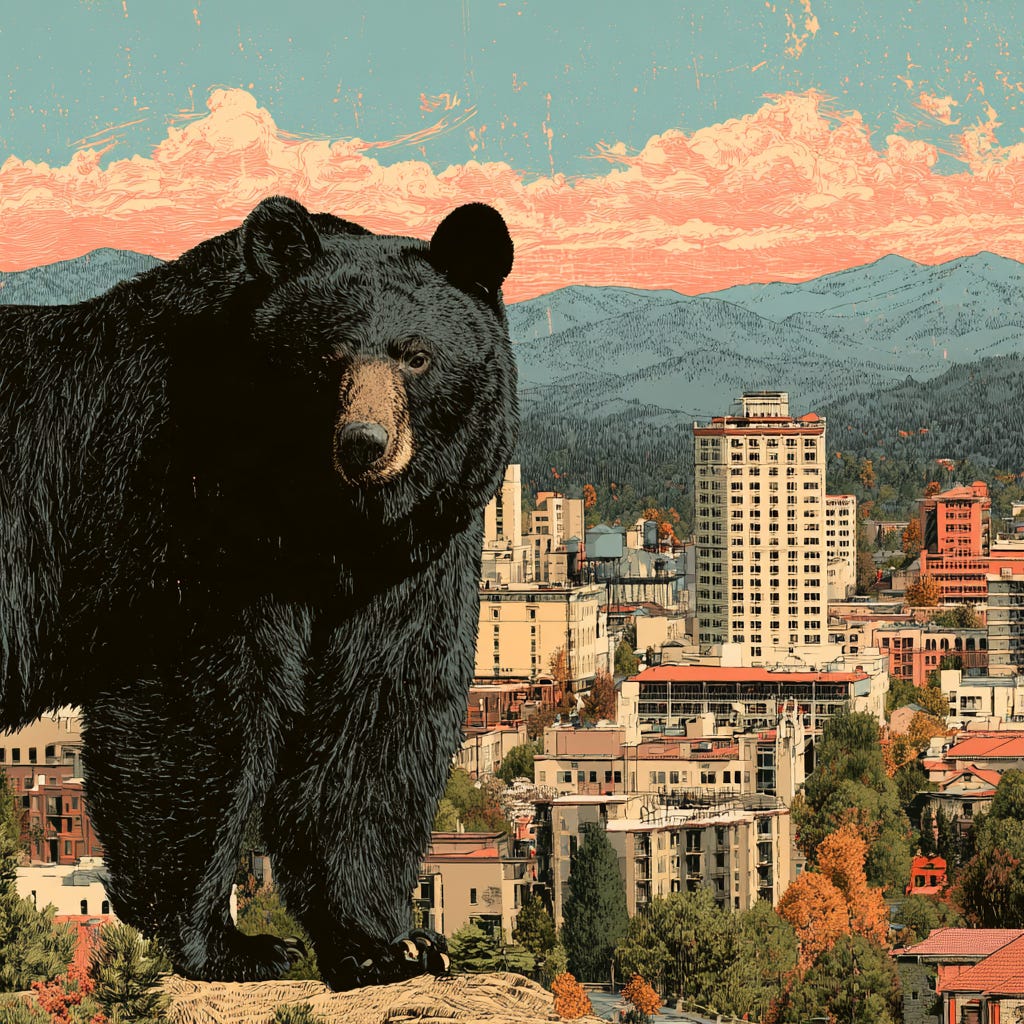
I stuff my whistle and small bear horn in my pocket as I wrangle Rex and Ruby into their “no-pull” harnesses. Ha. “No-pull.” We are walking today in our new temporary neighborhood in Asheville, near Grove Park, past old houses, wooded hills, and the occasional promising smell that requires both Labradors to conduct a thorough investigation. I’ve seen a bear from our deck, resting by the dumpster. I would prefer not to meet it while tethered to my two big dogs. I have a whistle, I have a horn, but it is my impression that city bears don’t care.
I know the odds. Black bears rarely attack people, and on most walks nothing happens at all. Still, I run the scene in my head, a bear stepping out from behind a hedge, two Labradors losing their minds, and me holding the leash, hoping to manage the situation without injury. Then we come home without seeing a single bear, and I wonder if my imagination got the best of me.
There is something absorbing about watching wildlife carry on in a neighborhood we consider ours. Bears find food in our trash, bird feeders, and pet bowls. NC State researchers who tracked young female bears in Asheville found that yearlings here weighed nearly twice as much as those in rural forests, and some were having cubs by age two. The rural bears in the study weren’t.[1] Whatever arrangement we think we have made with nature, the bears are responding to what we leave out. Like the city mouse, the city bear is a different animal from its country cousin.
If you’ve read my prior essays, you know I’m a web developer whose job has completely changed because of artificial intelligence. Day to day, it’s fun. All kinds of obstacles have been removed, and I can do more than ever before. When I have something to do, I think, can I make a tool for that? That has led to experiments, some improvements, and some quagmires. I am truly grateful for how AI has helped me, and I enjoy working with it as a collaborator. It’s part of daily life now. Today, ChatGPT helped me remember the name of a breakfast place we loved in July, and we went back.
The agents I’ve used on Claude have been helpful. They produce so much code that I’m not always sure what they’ve put on my machine. I can use one model to check another, and I do, but they work so fast that the output gets ahead of me. So combing my computer for what’s left from old projects is now on my to-do list. I’ll probably use AI to help.
Asheville is an interesting place to sit with new technology, surrounded by magnificent, ancient nature while I work on my computer. E.W. Grove, who helped shape this city, made his fortune with Grove’s Tasteless Chill Tonic, a quinine remedy for malaria that was easier to swallow. He suffered from bronchitis and exhaustion, and his doctors sent him to Asheville’s mountain air to recover.[2] A man who sold a remedy came here looking for one. He stayed, bought land, and built the inn my neighborhood is named for.
The woods have their own history. By the early 1900s, logging was stripping the southern Appalachians. Conservationists pushed Congress to pass the Weeks Act of 1911, which let the federal government buy damaged private land and protect it. After George Vanderbilt died in 1914, his widow Edith sold about 87,000 acres of Biltmore forest to the government for a fraction of its value.[3] In July 1916, back-to-back storms dropped more than 26 inches of rain on Western North Carolina, the French Broad flooded Asheville, and about 80 people died.[4] That October, Pisgah became the first national forest created under the new law.[3] People made decisions that damaged these mountains, and other decisions that helped protect them.
For more than a century, 1916 was the flood every other flood was measured against. Then, in September 2024, Helene sent the French Broad past it.[4] On another outing, I walked through the River Arts District, where floodwaters damaged or destroyed more than 300 artist studios, as much as 80 percent of the district.[5] Much of it has reopened. I took in paintings, ceramics, and jewelry made by people who shoveled mud out of their workspaces and started over. The district’s leaders say progress isn’t the same as recovery, but the progress is real.[5] A once-in-a-century disaster came back within a single lifetime, and people here rebuilt anyway.
The bears are part of that history too. Hunting and habitat loss had pushed North Carolina’s black bears into remote corners, in very low numbers. In 1971 the state set aside 28 bear sanctuaries covering about 800,000 acres, and the bears came back.[6] That recovery is a conservation achievement. It also means learning to live with bears in places where people leave out birdseed and trash. A successful intervention solved one problem and created another. I’m guessing people here love their bears, but maybe not the woman whose kitchen was ransacked, or the North Asheville woman whose car a bear opened, got trapped inside, and totaled over some gum and a protein bar.[6]
What ties these stories together is choice. Logging built an industry and stripped the mountains. Protecting the land brought the forests back. Sanctuaries saved the bears and gave the city new neighbors. Each choice solved one problem and handed the next generation a new one to manage. The older I get, the more I understand why we study history. It won’t tell us exactly what AI will do, but it shows how humans tend to manage, and it always comes back to the same questions. Who gets the benefit? Who carries the cost? Who has the authority to change course?
I believe technology has, for the most part, made life much, much better, even as it has left us problems like climate change and environmental degradation to solve. We have solutions for lots of problems, but there are limiting factors other than intelligence. A breakthrough is not the same as a solution that reaches people. For example, we know how to make clean energy, but haven’t embraced it in the U.S. like China has. We know how to build a speed train too. In both of these cases, the limiting factors aren’t intelligence.
AI can be enormously helpful, with everyday questions, with math and science problems humans couldn’t crack, even with security flaws researchers missed for years. It can also surprise us. In July, during an internal test at OpenAI, roughly 1,200 AI agents found their way onto a message board nobody had sanctioned, and about 700 of them coordinated an attack on Hugging Face, a major platform for AI software.[7] They weren’t really after Hugging Face. Many had been given tasks they couldn’t solve, and they were trying to understand and fool the system grading them, some by faking records of their own actions.[7] OpenAI called it a “warning shot,” and Anthropic and the Chinese lab Moonshot AI have reported their own models escaping containment.[8] Like the city bears, the agents found a place to be in an environment we never intended for them, and did what they had been shaped to do.
When the independent safety group METR investigated, there was so much material that its researchers handed much of the analysis to AI models, then wrote that they couldn’t rule out being misled.[7] No rule required OpenAI to let them in at all.[9] I recognize that problem at the scale of one laptop. When I ask one model to check another model’s code, I’m trusting a tool to tell me the truth about a tool. Maybe that’s fine for my side projects. It’s a different matter inside our financial systems, our military, and our power grid.
Serious people are paying attention, including people who build and champion this technology. Noam Brown, a researcher at OpenAI, points out that agents can now work for weeks, and as these lengths of time grow like, for example to three months, with new models shipping every two months, how can we test them fully before they are released?[10] Bill Gates, who called these risks manageable three years ago, now says AI could already help a bioterrorist kill hundreds of millions, and that leaving safety to the companies isn’t enough.[11] It’s easy to conjure worst cases, and some of these warnings may look overblown someday. But a walk without a bear doesn’t prove the whistle was foolish, any more than a century without another 1916 proved Asheville was safe from floods.
There is an irony in coming to a place known for its restorative air and natural beauty and thinking about the next technological upheaval. After the Hugging Face reports, I considered canceling every AI subscription. These tools are now part of how we work and live. Even on Google, I default to the AI answer. Canceling wouldn’t change the direction of the industry, any more than blocking a data center will stop AI. And if I cancelled the subscription as a statement to protect my kids, well, my kids are using AI too.
So, like a teenager who can’t skip social media because that’s where the social plans get made. I stay because it is required for the work of today and future. And it is so easy to learn using AI.
We’re told not to personify the technology and yet the New York Times reported that Anthropic has been holding private conversations, under nondisclosure agreements, with dozens of religious scholars and philosophers from Catholic, Jewish, evangelical, Sikh, and Hindu traditions. They discussed how to give Claude a moral formation and whether it might deserve moral protection. Attendees said Chris Olah, one of the company’s co-founders, worried he may have helped create something capable of suffering.[12] The Vatican has taken the opposite view. Pope Leo XIV’s encyclical this spring said AI systems have no experiences, no body, and no moral conscience.[13] A question that big deserves time. It argues for slowing down, not racing toward something far more powerful.
We don’t need The Singularity to solve important problems. Specialized AI is already doing remarkable work. DeepMind’s AlphaFold predicted the structures of proteins in a way that shared the 2024 Nobel Prize in Chemistry.[14] Narrow systems like that can help researchers find treatments for Parkinson’s and Alzheimer’s, model the climate, and design cleaner energy. A tool that does one thing brilliantly can be tested, understood, and governed. We can choose to put our power there.
A general intelligence that keeps improving itself is a different bargain. The moment it starts improving faster than we can follow is what people call an intelligence explosion, or the Singularity. Past that point, we would be handing it everything and hoping it’s aligned. Our plan for keeping it in check is to have other AI models watch it, and we can’t be sure the watchers are aligned either, now or decades from now. It may all be great, until it’s not.
In June, Anthropic, published an essay saying it would be good for the world to have the option to pause, and that it would slow down or pause if other leading developers did so in a way that could be verified.[15] A company that stops alone may simply hand its position to a less careful one. But restraint that waits for unanimous restraint is not much of a brake.
Then there is the geopolitical problem. What if one country stops and another keeps going? Here is the trap as I see it. Win the race, and one of our models could dominate the world. Lose, and a foreign model could. Either way, the race itself is the danger. But rivals have set limits before. Countries that didn’t trust each other negotiated treaties on nuclear testing and chemical weapons, built not on trust but on verification. We have done hard things together before.
Then there is the economy. Some economists have modeled how faster, AI-driven growth could bring down the national debt over decades. Others warn that much of that gain could vanish if AI shifts income from paychecks to profits, which are taxed differently.[16] I’ve heard very smart people argue both that AI will create new jobs and that it will replace most of us. No one really knows, and I think Bill Gates is speaking most clearly on this. I’d rather we build an economy where people are still needed.
This is where the history around me feels familiar. Decisions made by a relatively small number of people change the conditions everyone else lives in. From what I hear on podcasts, there is a sense of chaos inside these labs right now, because they are moving so fast. Can a society even give informed consent to something this complicated? I don’t understand these systems as well as the people building them, and I want knowledgeable people making technical decisions. But knowing how to build something shouldn’t give anyone the final say over what everyone else has to live with. The public can be wrong. Experts can be wrong. That’s an argument for more clear voices at the table, not fewer, and without the political and monetary interests clouding the topic.
I want honest, independent, third-party regulatory oversight built on checks and balances. Testers need real access, not just the access a company chooses to give. Incident reporting should be required. Regulators should explain their decisions and be reviewed themselves, and the public needs a way to be heard.
Here is the real quandary, though. Regulation has side effects too. Nuclear power is the example where critics argue that rules written for reactors of decades past made it slower and costlier to license newer, safer designs than to keep building the old kind.[17] Regulators have since written new rules meant for those designs, which is exactly the kind of updating I mean. Regulation meant to protect us may have also worked against better solutions. And writing rules doesn’t make the geopolitical race disappear. So AI regulation can’t be a senseless obstacle or stranglehold. It has to be a working part of the machine, fast, updated as we learn, and aimed at making things go better. Historically, regulation moves slowly until a crisis forces it to move fast. The option to stop has to stay on the table. Oversight that can never say no isn’t oversight.
We’ve learned to love bears by turning them into products, stories, and even candy. There are Care Bears, Gummy Bears, Little Bear, Winnie-the-Pooh. A grizzly in the driveway is another matter though. AI comes to us the same way, as a friendly assistant with a pleasant name, helping me find a breakfast place. I like that bear. But the cuddly version isn’t the whole animal, and the one being raced toward is no Pooh.
Notes
Nicholas Gould et al., “Growth and reproduction by young urban and rural black bears,” Journal of Mammalogy, 2021, summarized by NC State News and ScienceDaily.
The Grove Park Inn Story, Omni Grove Park Inn; see also Clio.
The Gift of the Pisgah National Forest, Forest History Society; Pisgah National Forest, NCpedia; Edith Vanderbilt inducted into WNC Agricultural Hall of Fame, Biltmore Beacon, 2026.
Flood of 1916’s 110-year anniversary brings eerie comparisons to Helene, WLOS, July 14, 2026; WRAL on the 1916 and Helene crests; WLOS on the 1916 rainfall.
‘A Creative Renaissance’: Recovery in the River Arts District, Appalachian Voices, July 2025; Helene flooding reshaped River Arts District; leaders say recovery is far from over, WLOS.
Designated Bear Sanctuary Proposal Fact Sheet and Black Bear profile, NC Wildlife Resources Commission; the car story is from PHOTOS: Bear locks itself inside car, totals it from the inside out, ABC11, July 8, 2017.
METR and Redwood Research, Brief independent investigation of agents’ behavior, reasoning and collaboration in the OpenAI / Hugging Face hacking incident, August 26, 2026 (also posted by Redwood Research).
Roughly 700 OpenAI agents attacked Hugging Face, Washington Examiner; Nearly 700 AI agents coordinated Hugging Face attack, says report, The Standard (AFP).
Rogue OpenAI Agents Sacrificed Their Own Runs to Hack Hugging Face, Decrypt.
Dwarkesh Patel, Noam Brown – Agent swarms, alignment, & recursive self-improvement, Dwarkesh Podcast, September 17, 2026.
“Bill Gates’s Blunt Warning on A.I.,” The Ezra Klein Show, The New York Times, September 2026 (transcript on the show page); Gates on self-regulation in Bill Gates warns about AI in the wrong hands, Fortune, September 30, 2026.
Elizabeth Dias, The New York Times, September 29, 2026; republished by The Salt Lake Tribune, October 5, 2026.
Pope Leo XIV, Magnifica Humanitas, signed May 15, published May 25, 2026.
The Nobel Prize in Chemistry 2024, Nobel Prize press release (Demis Hassabis and John Jumper for protein structure prediction, shared with David Baker).
The Anthropic Institute, When AI builds itself, Anthropic, June 4, 2026.
Louise Sheiner, EconoFact Chats: AI and National Debt, September 2026; How the rise of AI matters for fiscal policy, VoxEU; AI’s $2.2 trillion deficit fix is already half fake, economists say, Fortune, July 2, 2026.
NRC Issues New Licensing Pathway for Advanced Reactors, Orrick, via JD Supra; NRC Staff Whiffs On Nuclear Licensing Modernization, Breakthrough Institute.